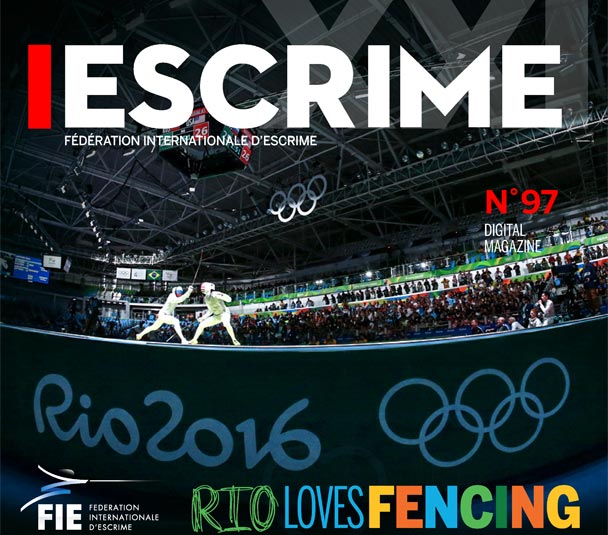
- OBRIGADO RIO!
2016 OLYMPIC
GAMES REVIEW - INÈS BOUBAKRI
THE HERO
OF TUNISIA - NEW FRONTIERS
FOR FENCING
GRAND PRIX
President: Alisher Usmanov (RUS)
Secretary General: Frédéric Pietruszka (FRA)
Secretary Treasurer: Jacek Bierkowski (POL)
Vice Presidents: Giorgio Scarso (ITA)
Wang Wei (CHN)
Ana Pascu (M.H.) (ROU)
Donald Anthony (USA)
Erika Aze (LAT)
Tamer Mohamed El Araby (EGY)
Max W. F. Geuter (M.H.) (GER)
Velichka Hristeva (BUL)
Emmanuel Katsiadakis (M.H.) (GRE)
Guk Hyeon Kim (KOR)
Novak Perovic (RSA)
Oleg Peskov (KAZ)
Ferial Nadira Salhi (ALG)
Yuki Ota (JPN)
Mbagnick Ndiaye (SEN), President, African Fencing Confederation
Vitaly Logvin (MEX), President, Pan-American Fencing Confederation
Celso L. Dayrit (M.H.) (PHI), President, Asian Fencing Confederation
Stanislav Pozdnyakov (RUS), President, European Fencing Confederation
Helen Smith (M.H.) (AUS), President, Oceanian Fencing Confederation
Chief Executive Officer
Nathalie Rodriguez M.-H. (FRA), CEO
Administration
Margarita Berdoz (BUL), Accounting Manager
Joana Almeida (POR), Administrative Assistant
Sophie Treyvaud (SUI), Assistant to the Director
Ylenia Murdaca (ITA), Rio 2016 Operations Assistant
Sport
Krisztian Kulcsar (HUN), Sport Director
Jie Ao (FRA), Deputy Sport Director
Elena Murdaca (ITA), Sport Administrative Manager
and Secretary General PA
ShinMi Lee (KOR), Sport Department Intern
Communication, Marketing, TV
David Nowak (GBR), Director of Communications
and Public Relations
Asimina Tsellou (GRE), Media Manager
Marina Shturbabina (UKR), IT Manager
Barna Heder (HUN), Head of FIE Television Production
Maria Ntanou (GRE), Digital Coordinator
Edited by the FIE
Quarterly review
N˚97
Director of publication
Alisher Usmanov
Coordinators
Asimina Tsellou
Maria Ntanou
Design
Touchline (www.touchline.com)
Translation
Libero Language Lab
Photography
Serge Timacheff, Augusto Bizzi
Official Publication of the FIE
International Fencing Federation
Head-office of the FIE
Maison du Sport International
Avenue de Rhodanie 54
CH-1007 Lausanne
Tel.: +41 21 320 31 15
Fax: +41 21 320 31 16
e-mail: info@fie.ch
www.fie.org
Dear friends,
As we move towards the end of what has been a
momentous year, the global fencing family can
look back with pride at its achievements.
There is no doubt that in the life of every sportsman and in each sporting organisation the Olympic Games mark the culmination of the four-year cycle. In 2016, the fans of our sport were rewarded with some gripping duels between the best fencers in the world. In Rio de Janeiro we witnessed fencing of the highest quality, a strong competitive spirit and a genuine desire to win!
Fencing has never enjoyed such international popularity as it does now, and to reinforce that point medals were won by fencers from 10 different countries and four different continents. Several countries, such as the Ivory Coast and Benin, took part for the very first time. The Olympic Games in Rio de Janeiro were a powerful growth driver for the popularity of fencing in South America.
I would like to thank the International Olympic Committee represented by Mr. Bach, the Organising Committee in Rio de Janeiro and all the volunteers, officials, spectators, coaches and athletes who made it such an unforgettable Olympic fencing tournament.
World fencing has already embarked on the next cycle and is now preparing for the 2020 Olympic Games in Tokyo. In the meantime, the third series of the Fencing Grand Prix in the 2016-17 season is approaching. New regional venues for this competition include Long Beach, California; Bogota, Colombia; and Cancun, Mexico.
Our World Championships will take place as usual at the end of the season, this time in Leipzig, Germany, where they were first held in 2005. Our Junior & Cadet World Championships, meanwhile, return to Plovdiv in Bulgaria, where competitions of a very high standard took place in 2014. Everyone who loves our sport will be eagerly awaiting absorbing duels ahead and new names making their mark in world fencing!
The 95th FIE Congress will be taking place very soon in Moscow, where the President, the Executive Committee and Members of the Commissions will all be elected for a new four-year term. It has been my pleasure and privilege to serve as your President for the past four years. I am confident that together with the newly elected team, we will ensure the dynamic development of fencing and I believe that world fencing will enjoy further success at the 2020 Olympic Games in Tokyo.
Alisher Usmanov
FIE President
The Rio 2016 Olympic fencing competition ended with Russia top of the medal table and was ‘among the most exhilarating in memory’ according to FIE general secretary Frédéric Pietruszka.
The Rio 2016 Olympic fencing competition has been hailed as one of the “most exhilarating in memory” by International Fencing Federation Secretary General Frédéric Pietruszka.
Speaking on the last day of the competition, which saw France win gold in the men’s team epee, the Secretary General expressed his delight at the quality of the fencing and the sheer drama on display at the Carioca Arena 3.
“London was a hard act to follow but the duels we have seen in Rio have been every bit as dramatic,” said the Secretary General, who won men’s team foil gold at the 1980 Games in Moscow. “Many of the finals have gone down to the wire and I think it’s no exaggeration to say the Rio 2016 fencing has been one of the most exhilarating in memory.”
Russia topped the unofficial fencing medal table with four gold, one silver and two bronze medals, the country’s best haul in two decades.
Hungary clinched second place with two golds, one silver and one bronze, while Italy was third with one gold and three silvers.
A total of ten sets of medals were won over the course of nine days of competition. It was an event that FIE Sport Director Krisztian Kulcsar spent much of the last three years helping to organise.
“This has been the greatest project of my life,” said Kulcsar, the 2007 world epee champion. “And I’m very proud to say the competition went very smoothly.
“Our No.1 goal was to provide the athletes with the ideal conditions in which to compete while putting on a real show for the spectators in the venue and the millions watching around the world. We arrived in Rio knowing London had set the bar high for Olympic fencing, and we leave feeling that we have truly done our sport justice.”
Several VIPs, including Italian Prime Minister Matteo Renzi and Hungarian President János Áder, dropped in to support their fencers. His Royal Highness Albert II, Prince of Monaco, His Excellency Sheikh Saoud Al Thani of Qatar, and American sprinting legend Michael Johnson were also in attendance during the nine days.
Meanwhile, the FIE’s Sport Initiation programme, allowing ticket-holders to give fencing a try under the supervision of coaches, proved very popular. An unofficial count by organisers put the total number of participants at over 3,000. IOC President Thomas Bach took part in the initiative before watching the men’s team foil final.
With the success of the Olympic fencing competition still fresh in the memory, it was the turn of the Paralympians to inspire and entertain at Rio 2016. Part of the Paralympic Games since its inception in Rome 1960, wheelchair fencing at Rio 2016 had 14 medal events for individuals and teams.
Fencers were given a classification depending on the type and extent of their disability. The classification system allows fencers to compete against others with a similar level of function. Fencing has two ability classes, A and B, two genders and three weapons, epee, foil and sabre. Wheelchairs were anchored to the ground during competition.
China won nine of the 14 gold medals on offer in Rio, Ukraine won two and France, Italy and Belarus one each.
Rio 2016 in Numbers
213 – Athletes
48 – NOCs
7 – most medals: Russia (4 gold)
2 – most successful athlete: Yana Egorian (RUS, 2 gold medals)
10 – countries won medals: Russia, Hungary, Italy, France, South Korea, Romania, USA, China, Ukraine, Tunisia
4 – continents won medals: Europe, North America, Asia, Africa
How the action unfolded in Rio:
Women’s Individual Epee
Men’s Individual Foil
Women’s Individual Sabre
Men’s Individual Epee
Men’s Individual Sabre
Women’s Individual Foil
Women’s Team Epee
Men’s Team Foil
Women’s Team Sabre
Men’s Team Epee
Results
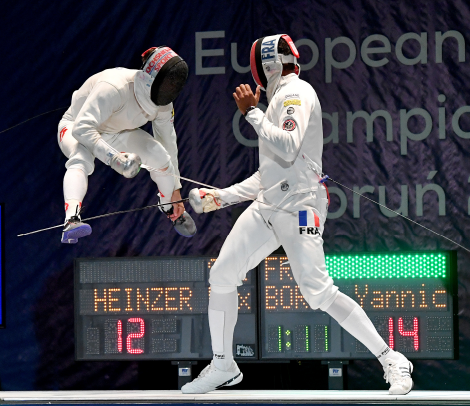
Yannick Borel claimed men’s individual epée gold and France won the men’s team event, while Romania’s Simona Gherman took the women's individual épée as Torun hosted Europe’s finest in June
Yannick Borel (FRA) won the gold medal in men's individual epee at the European Championships in June. He became the fifth different winner in the last five editions and in succeeding compatriot Gauthier Grumier he ensured France’s first back-to-back victories in men's individual epee since Hugues Obry and Rémy Delhomme won in 1998 and 1999 respectively.
French fencers have now won men's individual epee six times, second only to Hungary (7). Last year's silver medallist Max Heinzer (SUI) finished second once more and has now claimed five medals in this event, but never gold (S2-B3).
Timur Safin (RUS) won his first gold medal in men's individual foil. A bronze medallist in men's team foil in 2014, he became the third Russian to win this event, after Alexey Cheremisinov and Dmitriy Shevchenko. Erwan Le Pechoux (FRA) claimed the silver medal to add to bronze medals won in 2007 and 2014.
Benedikt Wagner became the third German to win men's individual sabre, after Felix Becker and Wiradech Kothny. Five-time champion Alexey Yakimenko (RUS) won bronze, for his 12th medal overall in this event (G5-S4-B3) – a record haul for a single individual event at the European Championships (both men and women).
France won men's team epee in back-to-back editions for the first time since 2003. It was the 11th medal in this event for France (G7-S2-B2), who have surpassed Hungary for the most podium finishes in men's team epee.
Russia won the European title in men's team foil for the second time, following their triumph in 2004. Russia are now one of four countries with multiple gold medals in this event, after Italy (8), France (4) and Germany (4). Italy’s silver medal was their record 13th medal overall.
Finally in the men’s competition, Russia won men's team sabre for the 10th time – a feat matched by their female counterparts in women's team sabre. It was the Russia women’s 10th gold medal, equalling the record for most golds in a specific team event. Italy have also won 10 gold medals in women’s team foil.
In women’s individual epee, Simona Gherman (ROU) joined Ildiko Mincza-Nebald (HUN) and Imke Duplitzer (GER) in the record books by winning a second gold medal. Gherman had previously won this event in 2012 as well as claiming bronze in 2014.
Ana Maria Popescu (ROU) took the silver medal, her fourth medal in this event in total (G1-S2-B1), joining Gianna Hablutzel-Burki (SUI, S2-B2) on a record four medals in women's individual epee.
In women's individual foil, Italy’s Arianna Errigo dethroned compatriot Elisa Di Francisca who had triumphed at the last three European Championships but now finished fifth. Errigo had previously claimed the bronze medal on three occasions (2009, 2012 and 2015).
Italian fencers have now won women's individual foil in seven of the last eight European Championships with golds for Di Francisca (four), Valentina Vezzali (two) and Errigo (one). Sofya Velikaya (RUS) successfully defended her title in women’s individual sabre, securing her fourth gold medal in the event, second only to Olga Kharlan’s (UKR) five.
With Kharlan winning bronze, Velikaya (G4-S3) and Kharlan (G5-S1-B1) have joined Ilaria Bianco (ITA, G1-S1-B5) on a record seven medals in women’s individual sabre.
Estonia won women’s team epee for the second time, following on from their gold medal in 2013 and silver in 2015. France claimed the silver medal, their best result in women’s team epee after claiming the bronze on three previous occasions.
Russia broke Italy’s seven-year winning streak in women’s team foil at the European Championships, earning their first gold medal since 2008. They also won women's team sabre for the fifth consecutive time and for a record 10th time.
Seven questions for Tunisia’s Ines Boubakri, who at Rio 2016 wrote a new page in the history of African female fencing
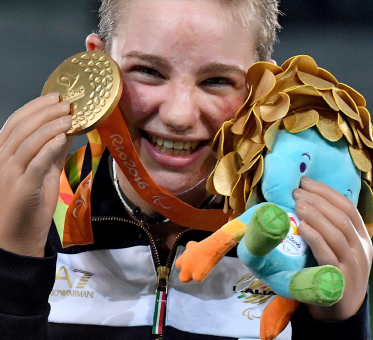
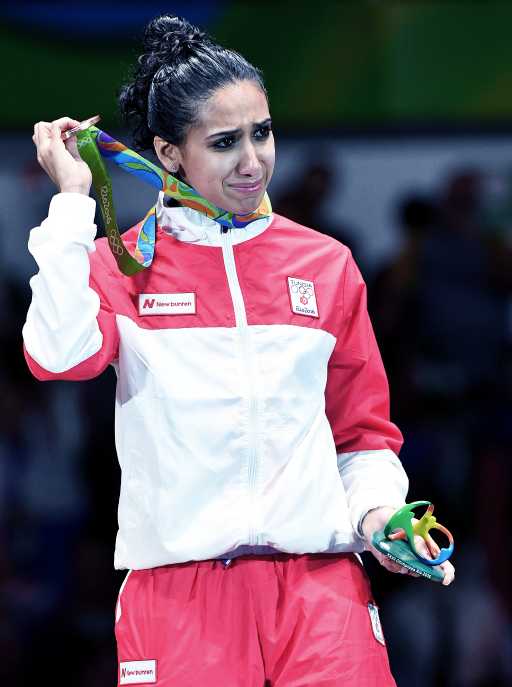
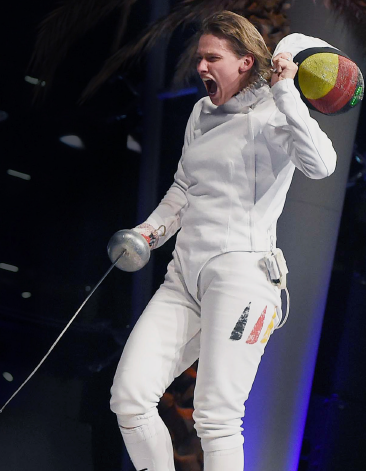
Ines Boubakri achieved a fencing first at the 2016 Olympic Games. When the 27-year-old world No.9 overcame Russia’s Aida Shanaeva 15-11 in the third-place playoff in women’s individual foil, she became Africa’s first female fencer to win an Olympic medal. Boubakri, the 10-time African champion, gives an insight into an unforgettable experience.
How did you feel right after the last touch on the piste in Rio?
I had a feeling of pride. I thought about the long road I’d travelled, the work I’d done with my coach Yann Detienne. I thought about my family. This moment will remain engraved on my soul – I felt unbelievable joy. I kept saying, “I’ve done it, I’ve got it”. I realised I’d made my dream come true. Once I had the medal around my neck I told myself that it belonged to me for ever. That moment seemed to go on for so long that I had time to think about my family again, and what this medal means to me and my country. I couldn’t hold back the tears and I wept for joy.
How would you describe your experience at Rio 2016 overall?
When I arrived, I felt stronger than ever but three days before my event, I found out the names of my opponents and panicked. I felt I wasn’t up to it. My next training sessions were catastrophic – from a technical and mental viewpoint– but little by little I regrouped. I thought about all the work I’d done. Whoever my opponents, I’d come to Rio to win. Come the event, I felt better as the day went on. Although I lost the semi-final, my fencing had been excellent against someone [Elisa Di Francisca] who’d always caused me serious problems and for the third-place playoff, I told myself, “I can’t stop here. Given the way I’m fencing, I’m going to try and get a medal.”
What did you do right after the Games?
I went back home to Tunis so that I could share my joy with my family. They gave me a hero’s welcome. I was received by the Sports Minister and government figures. All my family were there – my parents, my brothers, my friends, my aunts and cousins, and so on. I never thought that one day I’d receive this kind of welcome. I was in great demand with the Tunisian media at first so I wasn’t able to enjoy time with my family but after a few days I was able to catch my breath and spend a few days at the seaside.
What’s the daily programme of an Olympic medallist and what sacrifices do you have to make?
I train every day, once or twice a day, depending on weekend competitions and my class schedule. My training sessions consist of attack sessions – matches – as well as individual sessions we call lessons, and physical preparation. Lessons are very important. Apart from working on technique and sequences, they enable you to work in a specific way, with the coach, on particular actions or targeting specific fencers. We also do courses abroad to get ready for competitions. For the Olympics, I went to Avoriaz in France with my coach, fitness trainer and a few fencers from my club. It was a way to focus my training on fencers from abroad and to vary my defences.
To whom did you dedicate your Olympic medal and why?
I dedicated my medal to the Arab woman as she has her place in the society we live in and I hope that through my discipline I have been able to pass on my message. It’s also for my husband Erwann Le Péchoux, my family, and all the people who believed in me and helped me through the difficult times. I would just like to say an enormous thank you to them.
What do you enjoy doing as a break from fencing?
I love going shopping. I really like fashion but with training and going away for competitions I don’t often have time to go out because I prefer to rest and spend time at home. Whenever I do get the opportunity to go shopping with my friends, though, I really go for it!
What are your plans for the upcoming season?
The post-Olympic year is rather a special transition year. You’ve come to the end of a long sporting cycle which is very testing, both mentally and physically. The next Olympic Games are still a long way off. For me this will be the year for completing my Masters in Sport Expertise and High Level Performance studies. Then I’ll go on to the DEJEPS [fencing teacher] training course. Of course, I still have big sporting aims as well. Once my studies and retraining are completed, I’ll be able to start out again – with a calm, clear mind – toward a new Olympiad and think about Tokyo 2020. After these last three years and especially this Olympic medal, my ambitions are growing all the time.
Hundreds of visitors to the Carioca Arena 3 were able to try fencing for the first time during the Olympic Games thanks to the International Fencing Federation’s Sport Initiation programme
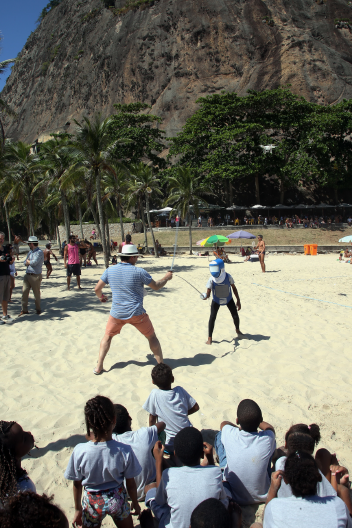
Long queues quickly formed outside the Olympic fencing venue on the first day of competition as the public waited eagerly for the chance to pick up imitation swords and fence against their friends.
For 44-year-old Julius from Sao Paulo, it was an education. “I’m trying fencing to get to know how it’s played, about the rules, and to know how the athletes feel when they are playing,” he said.
The Sport Initiation programme was part of the FIE’s Rio Loves Fencing campaign, a concerted drive to boost the popularity of the sport in Brazil. “This is pretty fun,” said one participant named Sterling. “I’m always intrigued by the way the lights come on when they hit the other person, and getting to actually try it is really cool,” he added. Sterling’s son Quincy piped up: “I figured out you have to poke them really hard!”
Sport Initiation follows a two-month Fencing School programme that visited more than two dozen educational institutions and community centres around Rio, teaching the basics of the sport to more than 3,000 children aged 5-15. Sport Initiation was available to Olympic ticket holders for the duration of the fencing competition, which ran from August 6-14.
The International Fencing Federation also distributed Olympic tickets to schools across Rio de Janeiro as part of its legacy and education programmes for the Games. An FIE delegation visited Rio before the Games to hand out hundreds of tickets to schoolchildren aged 5-15 at 27 places of education, providing access to the Olympic fencing competition for those who could not otherwise afford to go.
The schools included Escola Municipal Jose Enrique Rodó in the Rio suburb of Vila Valqueire, and Colegio Lemos de Castro, in Rio’s Madureira district. Many of the children took part in the FIE’s Fencing School program in March and April when 12 national-level coaches worked their way through dozens of schools and sports communities in Rio teaching kids the basics of the sport with equipment provided by the International Fencing Federation.
The FIE’s annual Congress takes place in Moscow in November with the elections for a new president and executive committee foremost on the agenda.
The International Fencing Federation will elect a President, the Executive Committee and Commissions when its member federations convene in Moscow on November 27 for the FIE’s 95th annual Congress. The Councils will be nominated by the Executive Committee in its meeting after Congress.
The President, Executive Committee and members of the commissions and Councils will serve a four-year term, in line with the Olympic cycle.
Congress will take place at the Ritz-Carlton Hotel, not far from Red Square and the Kremlin. The days either side of Congress will see the final meeting of the sitting Executive Committee and the first meeting of the newly elected Executive Committee.
The role of Congress is to establish, control and steer the general policy of the FIE. It determines the modifications to be made to the Statutes and the Rules for the competitions.
Each year Congress receives reports on the management of the Executive Committee and on the operational and financial situation of the Federation, the report on the accounts for the financial year that has ended and the report of the auditors.
Fencing now has a spectacular flagship competition taking place in iconic locations around the world and attracting new broadcast deals
Fencing has become one of the most vibrant and dynamic sports in the Olympic Movement. Exciting new technology and compelling presentation have made the sport fast, fun and more telegenic than ever before.
Major broadcasters already recognise this, handing primetime slots to Olympic fencing in the United States, France, Italy, Russia, the United Kingdom and dozens of other territories. Many national broadcasters are on board with multiyear broadcast deals for the FIE Fencing Grand Prix and World Fencing Championships.
With a rich and colourful history and a heritage based on sportsmanship, respect and discipline, fencing brings together the perfect elements for brand association and identity. The FIE is the TV rights holder for all official fencing competitions.
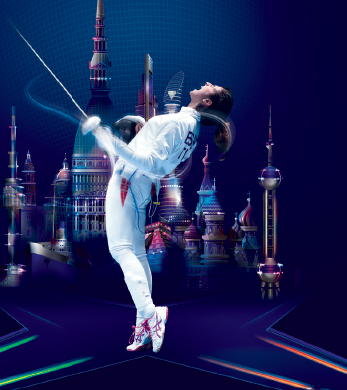
Now in its second year, the FIE Fencing Grand Prix series has taken root as fencing’s flagship regularseason competition. Taking in nine iconic cities around the world, the Grand Prix is a travelling exhibition of fencing at its explosive best.
FIE Sport Director Krisztian Kulcsar said: “The Grand Prix Series proved to us in its inaugural season that it has huge potential to showcase our sport as the truly spectacular entertainment that it is.
With the extremely good locations and the latest innovations in TV production, we are in a position to offer broadcasters something new and exciting, which is a rarity in this day and age. The fact that we have already signed several multi-year broadcast deals is a clear indicator that viewer appetite for world-class fencing is big and growing all the time.”
The 2016-17 calendar:
• Turin, Italy
2-4 December 2016
Men's and Women’s Foil
• Doha, Qatar
9-11 December 2016
Men's and Women’s Epee
• Cancun, Mexico
16-18 December 2016
Men's and Women’s Sabre
• Long Beach, USA
18-19 March 2017
Men's and Women’s Foil
• Budapest, Hungary
24-26 March 2017
Men's and Women’s Epee
• Seoul, South Korea
31 March-1 April 2017
Men's and Women’s Sabre
• Shanghai, China
19-21 May 2017
Men's and Women’s Foil
• Bogota, Colombia
26-28 May 2017
Men's and Women’s Epee
• Moscow, Russia
2-4 June 2017
Men's and Women’s Sabre
Fencers Club, the oldest fencing organisation in the Western Hemisphere, is playing a pivotal role in the Club Movement Initiative, whose good work continues worldwide
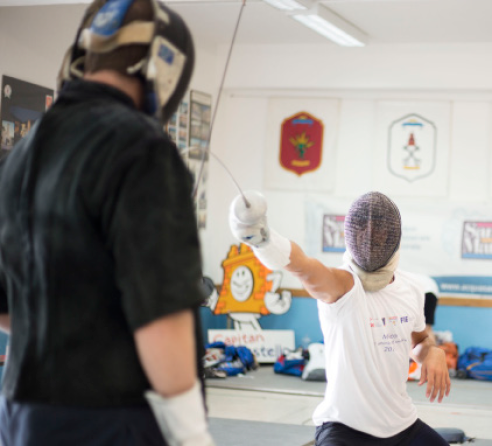
In close partnership with the FIE as part of its Clubs Movement Initiative (CMI), Fencers Club – the oldest fencing organisation in the Western Hemisphere – has made great strides to further the FIE’s mission of broadening the base and elevating the level of fencing worldwide.
As the representative club for the Pan-American region, Fencers Club has hosted three CMI sessions since 2014: two month-long coaching advancement sessions and, most recently, a Pan-American athletic training camp in March 2016. All told, the CMI programmes at Fencers Club have trained 40 athletes and coaches from 15 Pan-American countries across all weapons and levels.
Participants train for between six and eight hours each days with our world-class coaching staff including Buckie Leach (US Women’s Foil Olympic Team Coach), Kornel Udvarhelyi (US Women’s Epee Olympic Team Coach) and Akhnaten Spencer-El (US Olympian and Coach). They also engage in yoga sessions developed specifically for fencers by Kamilla Vaksman (née Gafurzianova), Russian Olympic Team Foil Silver Medallist from London 2012, and intense physical conditioning and agility sessions developed for fencers and led by Verb Fitness.
Some CMI participants arrived already preparing for the Olympics yet others had never set foot in a fencing club – such as the two Jamaicans, a boxer and a cricket player, who joined the coaching session in March 2015 with the task of learning as much about fencing and coaching as they could from the FIE CMI coaching advancement programme in New York before returning home to kick-start Jamaican fencing. They founded two clubs and began recruiting new fencers in earnest.
Two of these newly minted Jamaican fencers attended our March and April 2016 FIE CMI Pan- American training camp, along with other Pan- American athletes who had qualified for the Rio Games. Having only fenced for a few months, the Jamaican fencers put in extra hours on top of an already impressive training schedule to develop themselves as both athletes and ambassadors for the sport.
One of the Jamaican fencers was so taken with the programme that she wrote afterwards: “The view of people working hard, day and night, in New York City drove me to be on that grind as well. I developed a love for the Fencers Club and the FIE CMI programme and hope some day that I can give back.”
Away from the Pan-American region, the final months of 2016 have witnessed a series of CMI courses in Europe and Asia.
Vasas (HUN): September 19-October 14, 6 athletes (sabre) from Serbia, Poland, Czech Republic, Spain, Israel, Bulgaria Modica (ITA): September 10-October 10, 6 athletes (foil) from Armenia, Finland, Georgia, Ireland, Netherlands, Serbia Tauber (GER): October 10 –November 7, 6 athletes (epee) from Azerbaijan, Croatia, FYR Macedonia, Greece, Slovakia, Turkey Tokyo (JPN): October 11-23, 21 athletes (sabre) Beijing (CHN): November 1-15, 23 athletes (epee)
As an illustration of the benefits of these courses to European fencers, the six participants at the course in Modica, Sicily were Under-23 foil fencers from countries where there is a desire to develop fencing technique: Maykl Hovhannesyan(ARM), Petra Rousu (FIN), Luka Gaganidze (GEO), Phillip Cripwell (IRL), Patrick Post (NED) and Luka Stiklica (SER).
These athletes worked with programme director Eugenio Migliore and his fellow coaches Giancarlo Puglisi and Leandro Giurdanella, together with instructor Stefano Pedriglieri and athletic director Emanuele Cappello. They worked 30 hours a week over the four-week course, with two daily training sessions – morning lessons covering everything from physical preparation to footwork, before bouts in the afternoon.
Fencers Club is grateful to Mr Alisher Usmanov, the FIE and the International Charity Fund for the Future of Fencing for the opportunity to share our resources and infrastructure and promote our common goals. To learn more about the CMI program at Fencers Club, please visit the Fencers Club website.
To check out videos from all three CMI programs and more, visit here
From ice hockey Olympic Qualifiers for PyeongChang 2018 to world-class competitions from around the globe, the Olympic Channel will present live coverage of more than 35 events in partnership with 10 International Sports Federations (IFs) in 2016.
The new, ground-breaking digital platform where fans can experience the power of sport and the Olympic Movement all year round is now available worldwide via mobile apps for Android and iOS devices and at olympicchannel.com after launching 21 August following the Rio 2016 Closing Ceremony.
The Olympic Channel collaborations to broadcast events aim to complement the International Federations’ current broadcast and distribution arrangements. In addition to these events, the Olympic Channel team is currently working with the IFs to create innovative partnerships, including event coverage, highlights, magazine shows, news coverage and original programming with further announcements expected this Fall.
“We look forward to working with our IF partners to help distribute their events and extend their reach to fans around the world. Placing a spotlight on Olympic sports and athletes outside of the Games themselves is one of the key priorities of the Olympic Channel,” said Mark Parkman, General Manager of the Olympic Channel. “Launching the Olympic Channel with this event programming already in place ensures that fans will be able to continue their excitement of Rio and the Olympic Games all year long.”
Olympic Channel agreement with the FIE include the following fencing events:
2 - 4 Dec. : Torino Fencing Grand Prix (Torino, IT)
9 - 11 Dec. : Doha Fencing Grand Prix (Doha, QA)
16 - 18 Dec. : Montreal Fencing Grand Prix (Montreal, CA)
Click here for more information
Britta Heidemann from Germany (fencing), Seug-min Ryu from Korea (table tennis), Daniel Gyurta from Hungary (swimming) and Yelena Isinbayeva from the Russian Federation (athletics) have been elected to the International Olympic Committee (IOC)’s Athletes’ Commission by their peers at the Olympic Games Rio 2016 for a term of eight years.
IOC President Thomas Bach said: “The athletes are at the heart of the Olympic Games. Their voice is very important in the IOC. My congratulations go to the newly elected members of the IOC Athletes’ Commission. We are looking forward to working closely with them to further advance the Olympic Movement.”
Heidemann was elected with 1,603 votes, followed by Ryu with 1,544, Gyurta with 1,469 votes and Isinbayeva with 1,365. A total of 5,185 athletes voted. The four new members will replace outgoing members Claudia Bokel, Dae Sung Moon, Alexander Popov and Yumilka Ruiz Luaces, who were elected to the Athletes’ Commission at the Beijing Games in 2008 for a term of eight years each.
Claudia Bokel, who will be handing over the title of Chair of the Commission to Angela Ruggiero at the end of the Games, said after the announcement: “Congratulations to the four newly-elected members to the IOC Athletes’ Commission, which is the voice of all the athletes within the Olympic Movement. I wish them all the best in their contribution to the Commission under the leadership of incoming Chair Angela Ruggiero.”
Some 11,245 athletes were eligible to vote, and had 23 candidates from the same number of countries to choose from. Votes needed to be cast for four different athletes from four different sports. The candidates had to be presented by their National Olympic Committees, which were required to have their own athletes’ commission to select the candidate. In order to be eligible, the candidates had to have participated either in the Olympic Games in London in 2012 or in Rio in 2016.
The sudden death of Zsolt Kaposvári at the age of 48 was a source of great sadness across the world of fencing. He passed away on April 14 in Wuxi, China, where he had travelled to referee at the Asian qualifying event and Asian Senior Championships. He was a Hungarian national champion sabre fencer, and after an active sports career he became one of the world’s leading referees.
Zsolt Kaposvári started fencing in 1977 and participated in the Junior World Championships representing his club, Honvéd. During his career he won team gold in the seniors.
His results were:
• 1988 – Junior World Cup: 8th place
• 1990 – Senior Hungarian Team Championship: 1st place
• 1990 – Senior Hungarian Individual Championship: 7th place
• 1991 – Champions League: 2nd place
• 1991 – Senior Hungarian Team Championship: 1st place
• 1992 – Champions League: 4th place (’B’ National Team)
• 1993 – Champions League: 3rd place
Kaposvári retired as a fencer in 1994 and started refereeing, finding success in this field quickly. As a referee with a licence for all three weapons, he refereed in the finals of the 2012 London Olympic Games, and the 2008 Beijing Olympic Games, and Paralympic Games. Prior to his death, he had been assigned to the 2016 Rio Olympic Games by the FIE.
He also refereed in the:
• Senior World Championships in Moscow (2015), Kazan (2014), Budapest (2013), Catania (2011), Paris (2010), Antalya (2009), St. Petersburg (2007), Turin (2006).
• Junior and cadet World Championships in Acireale (2008), Belfast (2009), Baku (2010) and Plovdiv (2014).
Additionally, Kaposvári officiated at many Zonal Championships, World Cup and Grand Prix competitions. He was nominated by the FIE as an elite referee in 2014 and 2015, and third best referee in the world in 2012. He was best referee in Hungary for six years running between 2005 and 2010.
In 1997, he graduated from the marketing college of the Economic University of Pennsylvania. In 2006, he earned an MBA English College degree in marketing. In 2009-2010, he was a member of the Hungarian Paralympic Committee in the role of Marketing Division Leader. The FIE and the sport of fencing have lost a talented fencer and a remarkable referee of great merit. But above all, the FIE has lost a great friend who was appreciated and respected by all. We would like to extend our sincere condolences and sympathy to his family, friends and to the Hungarian Fencing Federation in these difficult times.